The €450 question
€450 is not a universal European answer. It is a design constraint: a way to ask whether predictable family mobility can be separated from the financial, technical and residual-value risks of owning a car.

Imagine walking into a car dealership somewhere in Europe. You need a family car with enough space for children, luggage and the occasional long journey. You use it every day, but you are not interested in becoming the owner of a small and unpredictable financial asset. What monthly figure would be reasonable?
There is no single European answer. Income, household composition and geography all change the amount a household can devote to mobility. Even among countries with broadly comparable economies, the difference is substantial.
One way to make the question concrete is to construct a transparent household scenario. Eurostat reports median equivalised disposable income for households with two adults and two dependent children. To turn that figure into a representative household income, this scenario assumes that both children are under 14; the modified OECD scale therefore assigns the household 2.1 consumption units.1 Applying that factor to each country’s median, and then applying its observed share of household consumption spent on purchasing and operating personal vehicles, produces the following indicative envelope.2
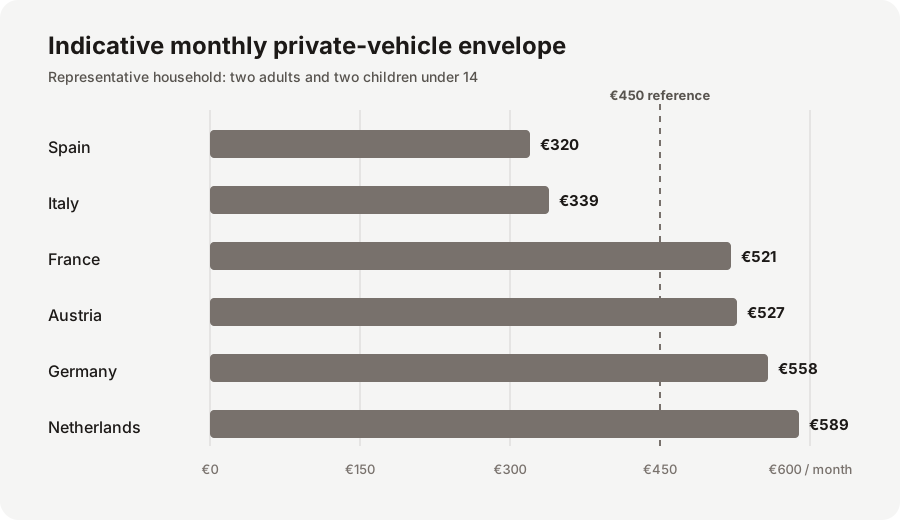
Modelled monthly amounts for a representative household with two adults and two children under 14. The dashed line marks the essay's €450 design constraint; it is not a recommended budget or an affordability threshold.
View accessible data table
| Country | Monthly envelope |
|---|---|
| Spain | €320 |
| Italy | €339 |
| France | €521 |
| Austria | €527 |
| Germany | €558 |
| Netherlands | €589 |
The range is more informative than its unweighted average of approximately €476. It shows that €450 is plausible as a design constraint, but not as a universal European norm. The calculation also excludes vehicle insurance and financing interest, and national expenditure shares describe average consumption rather than the behaviour of the median household.3 That perimeter is the statistician’s: purchase and running costs, fuel included, insurance and interest excluded. The Mobility Rate defined in Part 2 draws its line the other way, insurance and finance inside, energy outside. The two are not the same number and are not meant to be.
The number therefore belongs in the question, not in the evidence. You tell the person sitting in front of you:
I need a family car. I can spend €450 a month.
The €450 is what the household can commit every month whatever happens; fuel comes on top of it, as it always has.
Today, this apparently simple request immediately decomposes into several unrelated decisions. Which car can you afford, and how much should you put down? Should you buy, finance or lease? What will the car be worth in five years, and which insurance should you buy? How expensive will servicing become when the warranty expires or the engine develops a known problem? What happens if the car is damaged by hail, regulations change, your family becomes larger or your income falls?
The customer has asked a mobility question, but the industry responds with a collection of financial products, insurance contracts, warranties, maintenance schedules and uncertain residual values. Perhaps €450 is therefore the wrong answer; perhaps it should be the question.
1.1 The wrong question about affordable cars
European policy increasingly recognises vehicle affordability as both a social and an industrial problem. Current responses include social leasing for vulnerable transport users and work on smaller, lighter and less expensive European cars.4
These are legitimate responses: manufacturing cost, regulation, energy, labour and scale all matter. Yet they address only one dimension of affordability, the cost of the next vehicle supplied. Reducing the wider problem to the price of a smaller vehicle confuses affordability with size.
Mobility need does not necessarily scale down with purchasing power. A family with three children does not suddenly become able to use a B-segment hatchback because European industry finds it difficult to manufacture a larger family vehicle competitively; the mobility requirement still exists.
The relevant question is therefore not only:
How do we manufacture a cheaper car?
It is also:
How do we provide the appropriate amount of private mobility at a sustainable and predictable cost?
These are not equivalent questions. The first tends towards reducing the product; the second requires reconsidering the system around it.
1.2 A car is no longer a carriage with an engine
The modern automobile is simultaneously a mechanical machine, an electronic system, a software platform and a regulated safety device.
Since 7 July 2024, new passenger cars registered in the European Union have been required to include systems such as intelligent speed assistance, advanced emergency braking, emergency lane keeping, driver drowsiness and attention warning, and reversing detection.5 Euro 7 extends regulation beyond exhaust gases to brake particles, tyre abrasion and battery durability.6 Vehicle type approval also encompasses cybersecurity and the management of software updates.7
These are not ornamental additions to a carriage with an engine. They require sensors, computing, electrical architecture, validation, maintenance and organisational capability across the vehicle’s life.
This technological and regulatory complexity has contributed to vehicles that are safer, cleaner and more capable. Vehicle design is only one part of road safety, alongside infrastructure, enforcement, behaviour and emergency care. Even so, the direction of travel is visible: 19,940 people were killed on EU roads in 2024, 12 per cent fewer than in 2019, although progress remains too slow to meet the Union’s 2030 target.8
Capability is not costless: it adds components, validation, diagnostic procedures and repair requirements. European vehicle manufacturing also operates within a demanding industrial environment. Average hourly labour costs reached €34.90 in the EU and €38.20 in the euro area in 2025, with large differences between Member States.9 Industrial energy prices have retreated from their crisis peaks, but the Commission has documented a persistent competitiveness gap: EU industrial retail electricity prices were two to three times US levels during 2021–2023.10 At the same time, the automotive sector faces new technologies, stronger international competition and pressure to build cost-competitive battery supply chains.11
Much of the current industrial response therefore concentrates on lowering the cost of the next vehicle: simplifying regulation, reducing production cost, supporting battery supply chains and creating smaller affordable cars.411
This essay asks whether there is another variable available: the productive life of the capital already manufactured. Produce the expensive object, then stop throwing away its economic usefulness so quickly.
1.3 Owning mobility
Transport is one of the essential services recognised by Principle 20 of the European Pillar of Social Rights.12 This does not create a right to own a car. It does establish a useful starting point: people need affordable access to work, education, healthcare and social life.
Private mobility is not equally substitutable everywhere. In 2021, 61.1 per cent of the EU population lived in towns and suburbs or rural areas, rather than cities, and multimodal choices diminish substantially as distance from urban centres increases.13 The Commission’s 2025 transport-poverty factsheet reports that peri-urban residents often face the highest transport costs and that, in 12 Member States, more than 30 per cent of low-income families with children cannot afford a car.14
Geography therefore changes the economic value of having a vehicle immediately available. For many rural, remote and peri-urban households, a privately available car provides something that a timetable or an occasional ride cannot fully replace: the practical ability to leave when necessary, carry the people and objects required, and return on terms compatible with work and family life.
This is not evidence that every household must own the material asset. It suggests that two forms of ownership, bundled together by the twentieth-century automobile, can be separated.
The household needs control over its mobility. It does not necessarily need permanent title to the steel, aluminium, copper, electronics, battery cells and other industrial capital that make that mobility possible; nor should this separation prevent it from building a transparent claim on the material value it helps to finance, or from eventually choosing ownership.
Leasing and long-term rental already separate use from legal title. In their conventional forms, however, they can preserve the same dependence on residual-value assumptions and vehicle turnover through a different financing interface. The deeper question is whether material stewardship can remain with a lifecycle system designed to preserve the asset’s productive value.
What if the vehicle were designed, financed and operated not for a single sale and ownership cycle, but for several successive periods of useful mobility?
This essay calls that model Managed Mobility Lifecycle, or MML.
Footnotes
-
Eurostat, Mean and median income by household type (EU-SILC), dataset
ilc_di04, and Glossary: equivalised disposable income. Eurostat’s modified OECD scale assigns a weight of 1.0 to the first adult, 0.5 to each additional person aged 14 or over and 0.3 to each child under 14. Theilc_di04category identifies two dependent children but does not report their ages; treating both as under 14 is a scenario assumption, not an observed household characteristic. ↩ -
Eurostat, Final consumption expenditure of households by consumption purpose, dataset
nama_10_co3_p3. For each country, the model calculatesmedian equivalised disposable income × 2.1 × (CP071 + CP072) ÷ 100 ÷ 12, using CP071, purchase of vehicles, and CP072, operation of personal transport equipment, as percentages of total household final consumption expenditure. The displayed values are rounded to the nearest euro; the downloadable dataset retains the inputs and unrounded results. ↩ -
The envelope is an editorial comparison derived from two official datasets, not an official Eurostat indicator. The EU-SILC household category includes dependent children of different ages; treating both children as under 14 is an explicit scenario assumption. The national-accounts observations use the latest common year available for the six countries and some are provisional. The model excludes transport services, vehicle insurance and financing interest. It also combines median equivalised income with average national consumption shares, so it should not be interpreted as observed spending by a median family or as a recommended budget. ↩
-
European Commission, Industrial Action Plan for the European automotive sector, 5 March 2025; European Commission, Affordability: transport. ↩ ↩2
-
Regulation (EU) 2019/2144, type-approval requirements for general vehicle safety and the protection of vehicle occupants and vulnerable road users. ↩
-
Council of the European Union, Euro 7: Council adopts new rules on emission limits for cars, vans and trucks, 12 April 2024. ↩
-
Commission Delegated Regulation (EU) 2022/2236, requirements concerning cybersecurity and software updates in EU vehicle type approval. ↩
-
European Commission, Road Safety Statistics for 2024: Progress continues amid persistent challenges, 17 October 2025. ↩
-
Eurostat, EU hourly labour costs ranged from €12 to €57 in 2025, 31 March 2026. The figures cover the whole economy, not automotive manufacturing specifically, and are used here to describe the wider European cost environment. ↩
-
European Commission, The Clean Transition Dialogues: stocktaking, 10 April 2024. ↩
-
European Commission, Boosting the European car sector, reviewed 23 May 2025. ↩ ↩2
-
European Commission, Access to transport for all, including Principle 20 of the European Pillar of Social Rights. ↩
-
Eurostat, Urban-rural Europe — introduction, using population data by degree of urbanisation: in 2021, 38.9 per cent of the EU population lived in cities, 35.9 per cent in towns and suburbs and 25.2 per cent in rural areas; European Commission, Minding the gap: how rural transport inequality affects us all, 30 July 2025. ↩
-
European Commission, Transport poverty factsheet, May 2025. ↩