Digital News Outlets Are Becoming Legacy Acts — and Why This Matters for the Future of Information
After years inside and around newsrooms, I see digital news outlets increasingly resembling legacy acts — authoritative and culturally significant, yet structurally limited in how they evolve. Their challenge isn't overcoming that legacy but converting it into a foundation for new paradigms: verified information flows, trust-driven signals, and product models that can sustain relevance beyond the traditional news cycle.
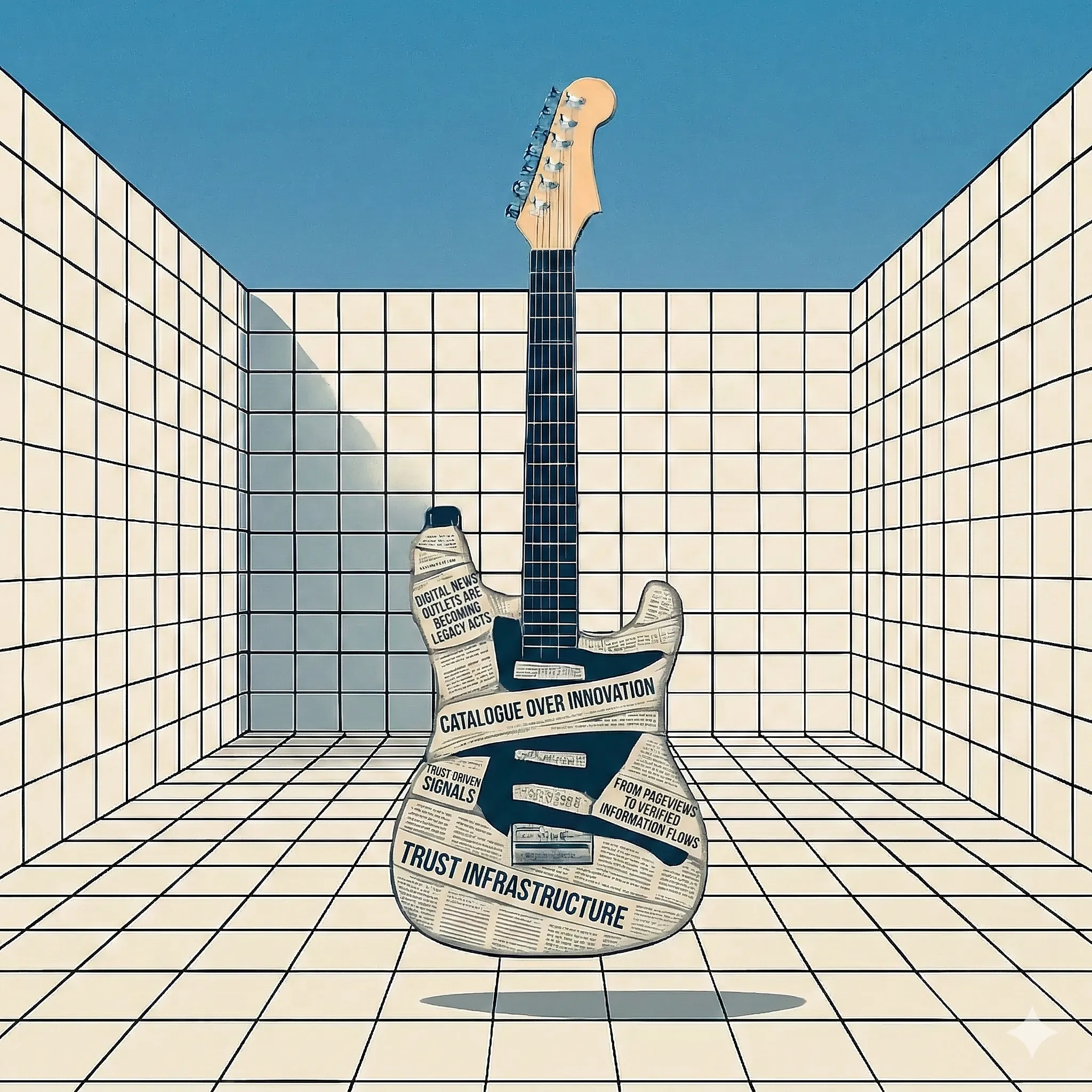
For years the media industry has discussed platform dependency, declining reader loyalty, and the impact of emerging technologies. Yet one dimension remains underexplored — and it’s one I keep coming back to: the extent to which many digital news outlets now resemble musical legacy acts, institutions respected for their past contributions but structurally constrained in how they evolve.
This isn’t nostalgia. It’s a lens I find useful for understanding the stagnation in the information ecosystem — and for spotting where the real opportunities for renewal are.
Legacy Dynamics in Digital Media
Legacy musical acts sustain their relevance through catalogue value, anniversaries, tours, and fan loyalty. Their historical identity is an asset, but it also defines expectations and limits experimentation.
Digital news outlets operate under similar pressures.
-
Catalogue over innovation. The archive—evergreen explainers, long-tail articles, institutional authority—generates a significant share of traffic and revenue. New formats struggle to deliver comparable returns.
-
Audience expectations shaped by history. Readers expect continuity: a familiar editorial voice, predictable structures, and conventional narratives. This reduces the perceived freedom to rethink products, workflows, or distribution models.
-
Recurring tentpoles as “touring equivalents.” Elections, major events, live blogs, and investigative series function as periodic spikes of relevance. Their role mirrors the revenue and attention cycles of legacy artists on tour.
-
Incremental updates instead of structural redesign. Redesigns, CMS upgrades, and workflow optimizations maintain operations but rarely reconfigure the product fundamentally.
These patterns point to something I’ve observed firsthand: digital news outlets have matured faster than they have transformed, and now face conditions where incremental improvements are no longer enough.
Why This Matters for the Future of Information
Calling digital outlets legacy acts isn’t a critique — it’s a way to understand the gap between institutional relevance and innovation capacity, a gap that generative AI, changing consumption habits, and platform volatility are widening every day.
If we want to move beyond maintenance and toward genuine renewal, I think the industry needs new paradigms:
-
From pageviews to verified information flows. Authority will increasingly depend on structured data, provenance systems, and transparent verification layers.
-
From top-down narration to audience-integrated formats. User contributions, micro-insights, and participatory mechanisms can complement traditional reporting.
-
From a single editorial product to modular information services. Outlets can develop APIs, data layers, topic-centric verticals, and analytical tools, broadening both utility and monetization.
-
From content distribution to trust infrastructure. In a landscape shaped by AI summarization, the value shifts from “publishing articles” to “providing reliable signals that can be ingested, interpreted, and certified.”
Legacy status is an advantage — brand equity, historical credibility, editorial expertise. But these assets need to be connected to new operational and product models that can redefine how information is produced, distributed, and consumed.
The challenge isn’t to overcome the legacy. It’s to convert it into a foundation for what comes next.
This is the question I’ve kept returning to in the months since writing this — and it’s led me down three specific paths: rethinking the economics of the publisher as a firm, redesigning how interaction becomes data, and solving who funds the journalism that doesn’t convert.